Top Indoor Grass Mat Options for Global Buyers

Time:2026-11-04 Author:Amelia
0%

Choosing an Indoor Grass Mat is not just a matter of finding the brightest green. Indoor light, foot traffic, and cleaning routines all affect how a mat performs. A soft surface beside a play area may need different fibers from a firm mat used for displays or light exercise. Details matter. Fiber height, stitch density, backing, and edge finish can change both comfort and stability. A glossy product photo rarely shows these differences.

This guide compares options through practical details global buyers can verify. It considers intended use, surface feel, maintenance needs, packaging, and supplier documentation. Buyers should request clear specifications and, where possible, a physical sample before placing a large order. Run a hand across the pile. Check whether the backing stays flat on the floor. Small checks can catch real problems. Product claims and test documents also deserve careful review, since requirements may vary by destination and use. No single Indoor Grass Mat will suit every room, budget, or buyer. Even careful comparisons have limits: colors can look different under indoor lighting, and sample pieces may not reflect an entire shipment. That uncertainty is worth admitting. The aim here is to help readers ask sharper questions, compare products on relevant features, and choose with realistic expectations rather than relying on appearance alone.
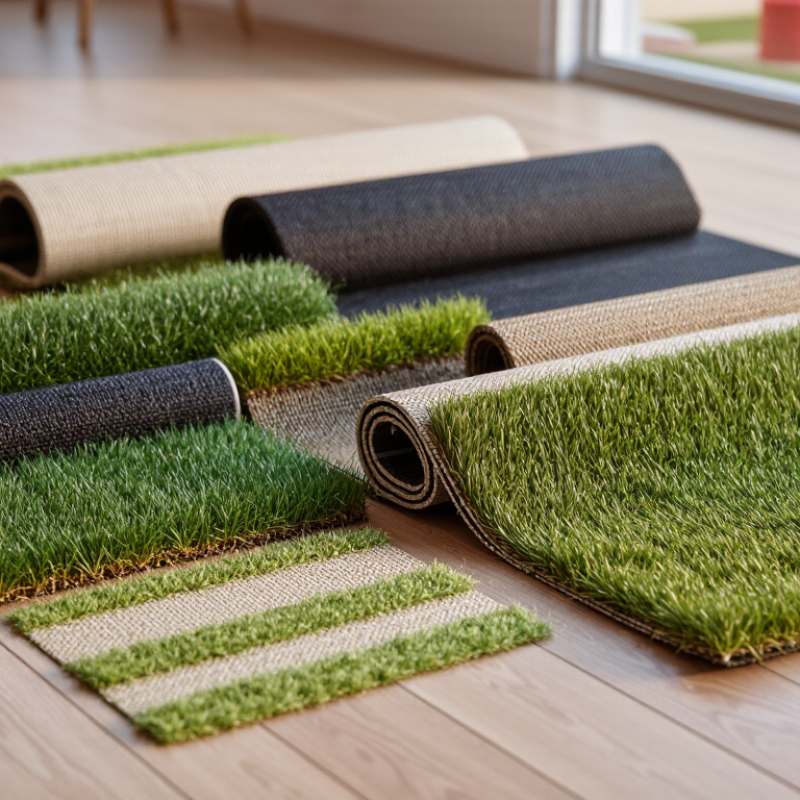
Top Indoor Grass Mat Options for Global Buyers

What Indoor Grass Mats Are and How They Are Made

Indoor grass mats are manufactured floor coverings that imitate the look and feel of short lawn. They are not living grass, so they need no soil, sunlight, or mowing. Common uses include indoor play corners, display areas, and small practice spaces. The surface is usually made from synthetic fibers, often polyethylene or polypropylene, selected for their flexibility and wear resistance. Feel the pile. It may be soft, firm, or somewhere between.

Production usually begins by melting plastic resin and forming it into thin yarn. The yarn is cut or textured, then tufted through a backing fabric to create rows of grass-like strands. A secondary coating, such as latex or polyurethane, may hold the tufts in place. Some backings include drainage holes, though indoor mats do not always need them. The coating is applied and cured, and the finished sheet is trimmed to size. Small details matter.

Manufacturing is not perfectly uniform. Pile height, density, and shade can vary slightly between products, and the backing affects grip and flexibility. A dense surface may look more lawn-like, but it can trap crumbs and dust. That trade-off is easy to overlook. Before choosing a mat, check its dimensions, edge finish, backing material, and care instructions. A close look at the underside often reveals more than a product photo.

Key Features That Distinguish Indoor Grass Mat Options

Indoor grass mats can look similar in photographs, yet their feel changes with pile height and fiber density. A short, dense pile tends to feel firmer underfoot and is easier to vacuum. Longer fibers create a softer, fuller surface, but crumbs and pet hair can settle between them. Small details matter.

Backing is another key difference. A grippy backing can help keep a mat steady on smooth flooring, though it should suit the floor finish beneath it. Bound edges are less likely to curl when people step across them. For rooms near an entryway, check whether the mat can be lifted easily for cleaning. A heavy mat may stay put, but moving it can become a chore.

Ask how the fibers respond to regular brushing and ordinary indoor light. A small sample is useful: place it beside a window, walk over it in socks, then vacuum it. That trade-off matters. I would not treat a softer sample as automatically better; comfort depends on where the mat will sit and how often it needs care. Care instructions should be clear, especially for moisture or stains, since aggressive scrubbing may flatten the pile.

Top Indoor Grass Mat Options for Global Buyers

Key Features That Distinguish Indoor Grass Mat Options

Pile height is one practical way to compare indoor grass mats: shorter piles tend to suit doorways and areas under furniture, while longer piles offer a softer, fuller look. The ranges shown are illustrative specification bands, not universal standards; actual products vary by construction and intended use.

Common Indoor Grass Mat Types and Their Uses

Indoor grass mats generally fall into three groups: short-pile decorative mats, denser practice turf, and soft-backed play or pet mats. Short, low-pile surfaces suit balconies, entryways, and display areas. They are easier to vacuum and less likely to catch chair legs. Practice turf uses firmer fibers for putting, agility drills, or light workouts. Check the backing: perforations can help water escape, while rubberized layers may improve grip on smooth floors.

For children or pets, choose a softer pile with a stable, washable backing. Add a nonslip underlay if edges might curl. Small spaces matter. Mats can trap crumbs, hair, and moisture underneath, so lift and dry them regularly. Look for clear details on pile height, backing material, and cleaning limits; vague “all-purpose” claims are not enough.

Market context helps, but it cannot determine fit. Grand View Research’s Artificial Turf Market Size report valued the global market at USD 4.89 billion in 2023 and projected 6.3% annual growth through 2030. That forecast does not prove every indoor mat performs well. Compare fiber density, seams, and odor after unrolling; a sample often reveals texture better than a photograph. I would still test a small area first.

How to Compare Mats for Different Indoor Spaces

Choosing an indoor grass mat starts with the room, not the product photo. In a playroom, a soft surface and cushioned backing may matter more than a realistic grass look. For a hallway, choose a lower pile that is easier to vacuum and less likely to catch under a door. Measure twice. Door clearance is easy to overlook.

For kitchens or enclosed balconies, compare how the mat handles moisture and how quickly it dries. A dense backing may feel stable, but it can hold dampness against some floors. Check the care instructions and test a small sample if possible. Tile, wood, and carpet can each change how a mat sits and feels underfoot. Look for a backing that grips your floor without leaving residue.

For a home office, a thinner mat can work better beneath rolling chairs; long fibers may flatten or impede movement. In larger shared rooms, compare seams, edge finishing, and available dimensions so the surface looks deliberate rather than pieced together. Color can shift under warm bulbs, too. I would not judge by softness alone; cleaning becomes important after everyday spills. No option fits every room, and a sample may still look different once it is laid beside the furniture.

What Global Buyers Should Check Before Purchasing

For global buyers, a large market does not guarantee a suitable mat. Grand View Research estimated the global artificial turf market at USD 8.5 billion in 2023 and projected 6.4% annual growth from 2024 to 2030. This is market context, not proof of product quality. Request a dated, independent test report that identifies the exact mat construction and test methods. Check pile height, stitch density, backing weight, and fiber type; ask for a physical sample to assess shedding and odor.

Match specifications to the room. A training studio may need firmer footing and secure edges, while a display area may prioritize color consistency. Ask how the backing handles damp cleaning, whether seams lie flat, and what care routine the supplier recommends. Confirm relevant fire, chemical-emissions, and material documentation for the destination market; requirements and test scopes can differ. Looks matter less. A glossy photo cannot show whether fibers flatten after repeated foot traffic.

Tip: Request sample tiles from the production batch, not only a showroom piece. Compare the stated dimensions and weight with your own measurements, and clarify packaging, lead time, and replacement availability in writing. Reports are useful, but they may not reflect your floor, footwear, or cleaning habits. Test a small area first.

Top Indoor Grass Mat Options for Global Buyers - What Global Buyers Should Check Before Purchasing

Compare common indoor artificial-grass mat constructions by intended use and practical purchasing checks. Product specifications vary by supplier, so confirm the finished-product datasheet and request a representative sample before ordering.

Mat Option Typical Construction Common Indoor Uses Advantages Checks Before Purchase Care and Limitations
Low-pile synthetic turf Short synthetic yarns, often made from polypropylene or polyethylene, attached to a backing. Pile height and density vary by product. Display areas, temporary event flooring, play spaces, and decorative floor coverings where a lower profile is preferred. Generally easier to place under furniture and simpler to brush or vacuum than longer-pile styles. Confirm pile height, total thickness, face weight, backing type, edge finish, and whether the product is intended for the expected foot traffic. Vacuum or brush as directed by the supplier. A low pile may provide less cushioning than a thicker, padded construction.
Soft, longer-pile synthetic turf Longer synthetic yarns, commonly polyethylene or a blend of yarn types, with a backing that holds the tufts in place. Decorative installations, photo or display areas, and low-to-moderate-traffic spaces where a fuller grass-like appearance is desired. The longer pile can create a fuller visual effect and a softer surface feel. Request pile-height and density details, check how readily the pile recovers after compression, and inspect shedding and color consistency on a sample. May show footprints or furniture impressions more readily and can require more brushing to maintain an even appearance.
High-resilience synthetic turf Turf made with resilient yarn, often nylon, or a blend selected for recovery and wear resistance. Exact performance depends on yarn, tufting, and backing construction. Frequently used areas where repeated foot traffic or regular surface recovery is important. Some constructions are designed to resist flattening better than softer decorative piles. Ask for test information relevant to the intended use, including wear or pile-recovery data where available. Compare total weight and construction, not fiber name alone. Performance varies by product. Do not assume a fiber type alone establishes durability, comfort, or suitability for a particular use.
Low-profile loop or needle-punched grass mat Compact, low-profile synthetic fibers formed into loops or a dense felt-like surface, usually bonded to a backing. Temporary displays, event areas, utility spaces, and locations where a thin covering is more practical than a plush turf. Typically has a flatter profile, which can make it easier to roll, store, and fit around transitions. Check thickness, edge stability, backing grip, roll direction, and whether seams or cut edges need finishing. Usually offers less cushioning and a less realistic grass appearance than tufted, longer-pile turf.
Cushioned or foam-backed grass mat Synthetic turf bonded to a foam or other cushioning layer. The type and thickness of the cushion differ between products. Play areas, floor displays, or other settings where added underfoot cushioning is desired. The added layer can make the surface feel softer than turf installed directly over a hard floor. Confirm total thickness, cushion material, compression behavior, backing bond, floor compatibility, and whether the mat needs a separate non-slip layer. Extra thickness can affect door clearance and transitions. Check cleaning instructions and avoid assuming the mat is suitable as a fall-protection surface without relevant test data.
Perforated or drainage-backed turf Synthetic turf with openings or channels in the backing intended to let liquid pass through. Indoor areas where occasional water exposure is expected and the floor below can safely receive and manage the liquid. Openings in the backing can allow drainage rather than trapping all liquid above an impermeable backing. Verify the backing design, floor drainage plan, slip resistance when wet, cleaning procedure, and suitability for the specific indoor location. Drainage openings do not remove the need to clean and dry the mat and underlying floor. Not suitable where water must not reach the floor below.
Grass mat with non-slip backing Turf paired with a backing or underside treatment intended to reduce movement on a floor. Grip depends on the floor surface and product design. Small mats and defined areas on smooth floors, subject to checking the mat and floor combination. May help limit movement compared with a mat that has no grip feature. Test on the actual floor finish; confirm grip performance, backing compatibility, residue risk, and whether a separate underlay is recommended. Dust, moisture, floor coatings, and cleaning products can affect grip. A non-slip claim should not replace an assessment of the installation and local safety requirements.
Buyer and shipping checks for any option Request the complete product specification, including pile material, pile height, total thickness, total weight per area, backing, roll or mat dimensions, and edge treatment. Relevant to all indoor grass mat orders, including samples, small projects, and container shipments. Clear specifications make it easier to compare like-for-like products and estimate fit, handling, and shipping requirements. Confirm order quantity and dimensional tolerances, color and batch consistency, packaging, lead time, shipping terms, and documents required by the destination market. Request applicable fire, chemical, or slip-test reports for the intended use and jurisdiction. Test reports and regulatory requirements depend on the product, installation, use, and destination market. Verify that documents apply to the exact product being purchased.

Note: These are general construction categories, not a universal performance ranking. Fiber type, pile dimensions, backing, installation, and maintenance all affect how a mat performs.

FAQS

How does pile height affect an indoor grass mat?

Short, dense fibers feel firmer and are easier to vacuum. Longer fibers feel softer, but crumbs and pet hair can hide between them.

What should I check on the backing and edges?

Check that the backing grips your floor without leaving residue. Bound edges are less likely to curl under footsteps. Lift the mat to see whether cleaning feels manageable.

Which mat works best in a hallway?

A lower pile is usually easier to vacuum and less likely to catch under a door. Measure the door clearance first. Easy to miss.

What features matter in a playroom?

A softer surface and cushioned backing may matter more than a realistic grass appearance. Try a sample in socks, especially where children often sit or play.

Can indoor grass mats work beneath rolling chairs?

A thinner mat may work better in a home office. Long fibers can flatten or slow chair movement. I would test a chair on a sample before choosing.

How should I compare mats for damp areas?

Check how the mat handles moisture and how quickly it dries. Dense backing can hold dampness against some floors. Follow the care instructions, and test a small area.

What should I request when comparing products?

Ask for a dated, independent test report that identifies the exact construction and test methods. Compare pile height, stitch density, backing weight, and fiber type. Request a sample from the production batch.

How can I check whether a sample suits my room?

Place it beside a window, walk over it, and vacuum it. Compare its color under your room’s lighting, too. A sample can still look different beside furniture. Test first.

Conclusion

An Indoor Grass Mat is a manufactured surface designed to bring the look and feel of grass into indoor settings. It is commonly made by attaching synthetic fibers to a backing, with materials and construction methods chosen to balance appearance, comfort, durability, and ease of care. Options may differ in pile height, fiber density, backing stability, drainage design, and texture, so these features can affect how a mat performs in a particular space.

Indoor grass mats come in styles suited to areas such as play spaces, fitness rooms, entryways, and decorative interiors. When comparing options, consider the room’s size, expected foot traffic, moisture exposure, desired feel, and cleaning routine. Global buyers should also check product dimensions, material details, packaging, shipping requirements, and supplier specifications before purchasing. Matching these factors to the intended use can help buyers choose a practical mat that fits their space and expectations.


Amelia

Amelia

Amelia is a seasoned marketing professional with a wealth of expertise in our company’s core offerings. With an unwavering passion for driving growth and innovation, she plays a pivotal role in shaping our marketing strategies and enhancing brand visibility. A key aspect of her responsibilities......