A Craft Grass Mat is a small, textured surface made to imitate natural turf. It usually combines synthetic grass fibers with a flexible backing. Crafters use it for miniature gardens, model landscapes, dioramas, seasonal displays, and photography props. Picture a tiny picnic scene with green blades under a paper tree. The mat adds depth without soil, watering, or outdoor maintenance.
The term is not perfectly standardized. Some sellers describe hobby sheets as mats, while others classify them as artificial turf remnants. This difference matters because fiber height, backing strength, and cutting behavior can vary widely. Grand View Research identifies artificial turf as a growing global market, supported by demand for low-maintenance landscaping and decorative applications. However, large landscaping figures should not be treated as direct evidence for craft-mat sales. The categories overlap, but they are not identical.
For practical use, buyers should inspect pile density, color variation, odor, and backing flexibility. A dense surface can hide glue marks better. A thin backing cuts more easily around miniature paths. Indoor projects still need ventilation when adhesives are applied. The U.S. Consumer Product Safety Commission also emphasizes checking small decorative materials for age-appropriate use and choking risks. That advice is relevant when craft displays contain loose fibers or tiny accessories.
A reliable introduction must avoid exaggerated claims. Not every Craft Grass Mat is washable, recyclable, or suitable for children. Product specifications deserve closer attention. Used carefully, it becomes a convincing visual layer, not a complete substitute for living grass.
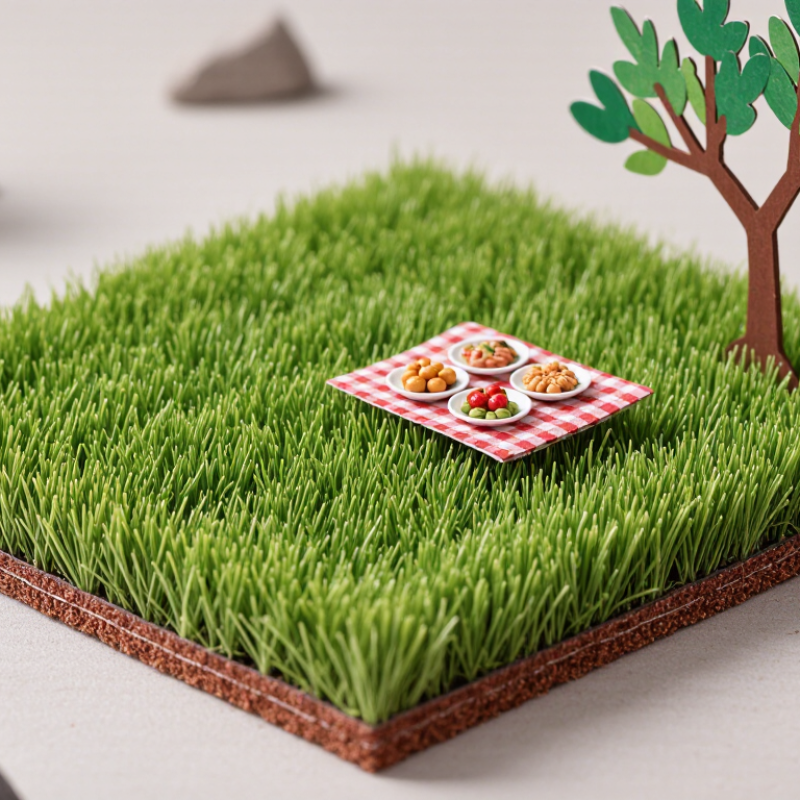
A craft grass mat is a small artificial turf surface used for miniature gardens, school models, displays, and seasonal decorations. Its grass fibers are commonly made from polyethylene or polypropylene. A latex or synthetic backing holds the fibers in place. Some mats also include a thin mesh layer for stability. The material feels different from natural grass, but it cuts more predictably with sharp scissors.
Pile height means the length of the visible fibers. A short pile, around 3–8 millimeters, works well for miniature roads, model parks, and detailed craft scenes. Medium pile creates a softer, fuller appearance. Long pile looks more realistic from a distance, yet it can hide small objects and become difficult to trim. Loose fibers may appear after cutting. That is normal, though excessive shedding deserves attention.
ASTM terms describe test methods, not automatic quality grades. ASTM D2859 may address flammability in finished textile floor coverings, while ASTM E84 reports flame spread and smoke development for certain materials. These results do not make a mat fireproof. ASTM F1292 and ASTM F1951 are often linked with impact or wheelchair-accessibility testing, but a craft mat should not be treated as playground surfacing without complete documentation. Check the exact product report, backing material, thickness, and intended use. A familiar ASTM reference can sound reassuring, but it may not apply to the entire mat.
| Data Dimension | Typical Information | What It Means | Common Craft or Display Use |
|---|---|---|---|
| Product Type | Small artificial-grass surface or flexible grass-textured mat | A manufactured textile surface designed to imitate the appearance and feel of natural turf. | Dioramas, miniature landscapes, model railway layouts, school projects, seasonal decorations, and photography props. |
| Primary Grass Fiber | Polyethylene (PE), polypropylene (PP), or a blend of synthetic polymers | PE is commonly selected for a softer feel, while PP can provide a firmer texture and economical construction. Exact performance depends on yarn shape and density. | PE fibers are suitable for realistic miniature lawns; PP fibers are often used for lightweight decorative pieces and craft backdrops. |
| Backing Material | Woven or nonwoven polypropylene backing, often combined with latex, styrene-butadiene rubber (SBR), or polyurethane (PU) coating | The backing holds the stitches in place and helps the mat retain its shape. Coatings may improve dimensional stability and reduce fiber shedding. | Cutting into small shapes, attaching to foam board, lining display trays, or creating a stable base for miniature scenes. |
| Typical Pile Height | Approximately 3–25 mm (about 0.12–0.98 in) | Pile height is the approximate length of the visible yarn above the backing. Short piles look closely cropped; longer piles create a fuller, more textured appearance. | 3–8 mm for miniature lawns and model bases; 10–15 mm for decorative tabletop scenes; 20–25 mm for a fuller visual effect. |
| Fiber Shape | Flat, oval, C-shaped, S-shaped, or fibrillated yarn | Fiber shape affects light reflection, resilience, texture, and the way the surface stands after handling. | Textured or curved fibers can create a more natural look in dioramas and display arrangements. |
| Color Construction | Single green tone or a blend of light green, dark green, olive, tan, and brown fibers | Mixed colors reduce visual uniformity and can imitate natural variation, dry grass, soil, or seasonal ground cover. | Green blends for lawns and parks; green-brown blends for woodland, rustic, autumn, or aged miniature scenes. |
| Density | Often described by stitches per metre, tufts per area, or total weight; specifications vary by construction | Higher density generally produces a fuller appearance, but density should be compared using the same measurement method and pile height. | Higher-density mats are useful when the backing should be less visible in close-up displays or photographs. |
| Cutting and Shaping | Usually cut with sharp fabric scissors, a craft knife, or a rotary cutter | The backing can normally be trimmed into curves, strips, patches, or irregular terrain shapes. Cutting may expose loose yarn or backing fibers. | Making miniature fields, garden borders, sports areas, hillsides, islands, and irregular landscape sections. |
| Attachment Methods | Double-sided tape, hot-melt adhesive, contact adhesive, PVA glue, hook-and-loop fasteners, or mechanical clips | The appropriate method depends on the backing, substrate, permanence required, and exposure to heat or moisture. Adhesive compatibility should be tested on a small sample. | Mounting the mat to cardboard, plywood, foam board, plastic sheets, display stands, or reusable craft bases. |
| Moisture Behavior | Synthetic fibers generally resist water absorption, but the backing and coating may retain moisture | The grass yarn itself may dry quickly, while glued, foam-backed, or coated assemblies may dry more slowly. Indoor craft mats are not automatically suitable for permanent outdoor use. | Suitable for dry decorative projects; allow wet-cleaned pieces to dry completely to reduce odor, mold, or backing deterioration. |
| Cleaning Method | Gentle shaking, soft brushing, low-suction vacuuming, or wiping with a damp cloth | Avoid excessive heat, aggressive brushing, and strong solvents because they can deform fibers, weaken adhesive, or discolor the backing. | Removing dust, paper scraps, flocking material, and loose craft particles from display surfaces. |
| ASTM F1292 | Standard specification for impact attenuation of surfacing materials within the use zone of playground equipment | This term relates to head-impact protection testing for playground surfacing. A craft grass mat should not be assumed to comply unless the complete product has documented test results for the relevant installation. | Relevant only when a mat is specifically designed and tested as playground surfacing; ordinary decorative craft mats are not automatically protective surfaces. |
| ASTM F1951 | Standard specification for determining the accessibility of surface systems under and around playground equipment | It evaluates whether a surface system can provide an accessible route for wheelchair and other mobility-device use under specified test conditions. Appearance alone does not demonstrate compliance. | Useful for evaluating purpose-built recreational surfacing, not for assuming accessibility of a small decorative or craft mat. |
| ASTM F355 | Test method for shock-absorbing properties of playing surface systems and materials | It provides laboratory procedures for measuring impact response using specified test apparatus. Results depend on the material, installation, thickness, and test configuration. | Helpful as a technical reference for sports or playground surfaces, but normally unnecessary for ordinary tabletop craft applications. |
| Safety Interpretation | Decorative craft use is different from certified playground or sports-surface use | ASTM references are test or specification terms, not automatic claims of compliance. Check the product documentation and installation conditions before using any mat for impact protection, public access, or athletic activity. | Use craft grass mats primarily for visual decoration, model making, displays, and controlled indoor projects. |
| Storage and Longevity | Store flat or loosely rolled in a cool, dry place away from direct sunlight and high heat | Proper storage helps reduce permanent creasing, color fading, fiber deformation, and backing damage. | Preserving unused material for future dioramas, seasonal decorations, classroom projects, and exhibition displays. |
It creates a grass-like ground surface for dioramas, school projects, displays, photography, and miniature gardens. Small scenes look finished.
The grass fibers are usually polyethylene or polypropylene. The backing may contain woven fibers, foam, or plastic.
Needles insert fibers into a primary backing during tufting. Pile height commonly ranges from 5 to 20 millimeters.
Latex or polyurethane coating improves stability and reduces fiber movement. Too little coating weakens adhesion. Too much may make the mat stiff.
They should measure pile height, stitch density, color consistency, dimensions, and backing adhesion. Fiber pull-out testing also reveals weak attachment. No mat is perfectly uniform.
Match the color with the scene’s season and lighting. Cut a narrow path through the surface. Pressing small stones into it can add believable detail.
Measure twice and mark the backing with chalk or a washable pen. Use sharp scissors or a craft knife on a stable cutting board. Apply suitable adhesive to the backing, not the grass.
Remove dust with a soft brush or gentle, low-suction vacuuming. Avoid soaking unless washing is specifically allowed. Store it flat or loosely rolled, grass facing inward.
Edges may shed fibers, seams may show, and corners may curl slightly. Weighting the mat overnight can reduce curling. My own storage method is not always perfect.
A Craft Grass Mat is a flexible, textured surface designed to create realistic grassy effects in dioramas, scale models, displays, and DIY projects. It is commonly made from synthetic or natural fibers attached to a stable backing. Important specifications include fiber material, pile height, surface density, backing type, and relevant ASTM terminology used to describe testing and performance. During production, fibers are typically inserted through tufting or similar methods, then secured with a backing layer and coating. Quality control may examine thickness, color consistency, fiber attachment, dimensional stability, and resistance to shedding.
The mat’s appearance and durability depend on the relationship between pile height, density, and backing strength. Taller fibers can create a more natural landscape effect, while denser fibers provide fuller coverage and better visual depth. For use, the mat can be measured and cut with suitable tools, attached with an appropriate craft adhesive, and shaped around model features. Gentle brushing or limited surface cleaning helps maintain its texture. Store it flat or loosely rolled in a clean, dry place away from excessive heat, moisture, and direct sunlight.

 Yameiju