What Is the Best China Car Grass Mat for Bulk Orders?

Time:2026-09-21 Author:Sophia
0%

Choosing the best China Car Grass Mat for bulk orders is not simply a price comparison. Large purchases expose small weaknesses quickly. A loose edge, sharp odor, or uneven backing can affect thousands of vehicles.

Chen Wei, an automotive interior materials specialist with more than 15 years of sourcing experience, says, “A reliable Car Grass Mat must perform consistently, not impress only in a sample box.” His point is practical. Bulk buyers should examine fiber density, cutting accuracy, anti-slip backing, moisture resistance, and packaging quality. A mat may look thick under showroom lights, yet flatten after repeated foot traffic. That difference matters.

Factory capability also deserves close attention. Ask for production photos, material specifications, and recent inspection records. Request samples from different production batches. One sample is not enough. Check the mat inside a vehicle, not only on a warehouse floor. Look for curled corners, trapped dust, fading, and movement near the pedals. These details reveal more than attractive catalog images.

Cost still matters, but the lowest quotation can become expensive after returns, delays, or customer complaints. Even experienced buyers sometimes overlook carton compression during long-distance shipping. That mistake is easy to make. A clearer purchase plan should include acceptable tolerances, inspection points, delivery schedules, and replacement terms. No supplier is perfect. The stronger choice is usually the one that documents weaknesses honestly and improves them consistently.
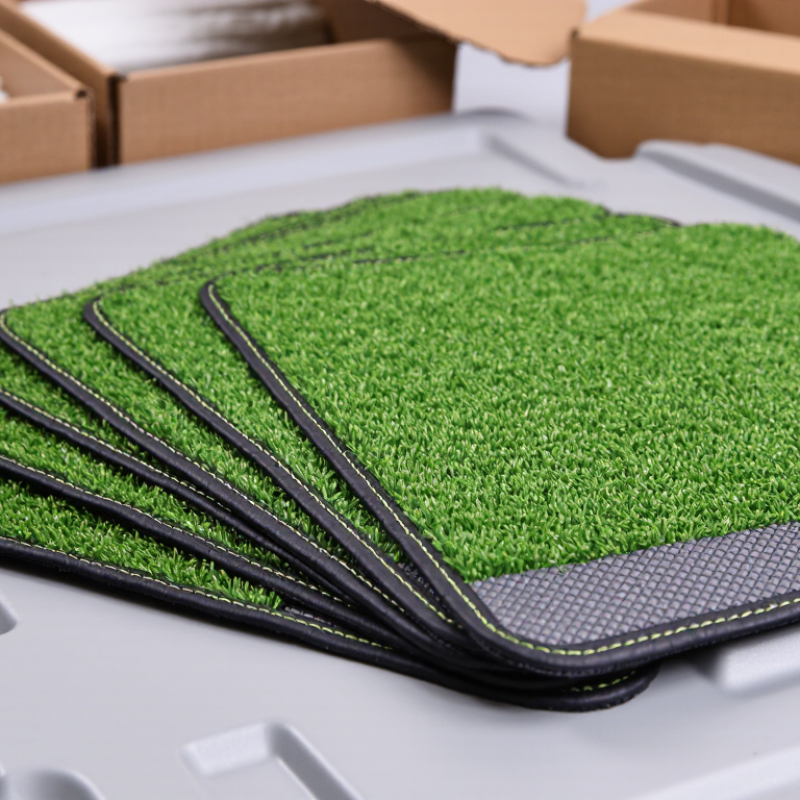
What Is the Best China Car Grass Mat for Bulk Orders?

Car Grass Mat Types: PVC, TPR, and Rubber Options for Bulk Buyers

For bulk buyers, the best car grass mat depends on climate, cleaning habits, and target price. China’s auto market remains substantial. The China Association of Automobile Manufacturers reported 31.44 million vehicle sales in 2024. That volume supports steady demand for replacement floor protection. PVC grass mats provide sharp molded textures and competitive unit costs. They fit fleet orders needing consistent dimensions. Yet PVC may stiffen in cold storage and retain odor after sealed packing. Request low-temperature and odor test results.

TPR mats feel softer and usually recover better after folding. They also offer a useful balance between grip, flexibility, and price. For mixed vehicle orders, TPR can reduce fit complaints. However, its performance changes with formulation. Ask suppliers for thickness tolerance, slip testing, and compression recovery data. A first sample can mislead. Measure five pieces from one production batch.

Rubber mats generally deliver stronger abrasion resistance and heavier underfoot stability. They suit commercial vehicles, rainy regions, and buyers expecting long service. Their disadvantages include higher weight, stronger odor risk, and increased freight cost. The China Rubber Industry Association’s industry reporting highlights energy and raw-material cost pressure across rubber manufacturing. This can affect quotations quickly. Compare landed cost, not factory price alone. For every material, review edge height, drainage channels, backing grip, recyclability claims, and packaging compression. Independent inspection remains worthwhile before a container-scale purchase.

Key Specifications: 8–12 mm Pile Height and 2,000–3,000 g/m² Weight

What Is the Best China Car Grass Mat for Bulk Orders?

For bulk orders, car grass mats should balance visual density, drainage, and production consistency. A practical specification is 8–12 mm pile height with a weight of 2,000–3,000 g/m². This range gives the mat a firm hand without making it excessively heavy. ISO 8543:2018 treats pile height and mass per unit area as separate measurements. Buyers should request both results, not rely on appearance alone. A thicker mat is not automatically better.

Recent automotive floor-mat market reports identify durability, vehicle fit, and easy cleaning as key purchasing factors. These findings support a denser construction for high-use interiors. However, excessive density may slow drying after washing. During factory inspection, check edge binding, backing adhesion, odor, color consistency, and dimensional tolerance. A useful sampling plan can test several pieces from different production batches. One sample is not enough. I have seen attractive first samples hide uneven backing or loose fibers in later cartons. That point deserves honest review.

Tips: Ask for a laboratory test sheet showing pile height, total weight, and abrasion results. Confirm whether the stated 2,000–3,000 g/m² includes backing. Test-fit samples in the target vehicle before confirming volume. Also inspect carton compression and moisture protection, because transport damage can reduce an otherwise reliable product.

Safety Screening: REACH Compliance, Odor Tests, and Flame Resistance

For bulk China car grass mat orders, safety screening should begin before production. Under REACH, suppliers must disclose Substances of Very High Concern above 0.1% in articles. Request material declarations, supplier test reports, and batch traceability. ECHA’s 2023 enforcement work found chemical non-compliance across many inspected products, showing why paperwork alone is not enough. Independent laboratory verification remains necessary.

Odor testing needs controlled conditions. Ask for a sealed-chamber or heated test, with temperature, sampling time, and detection limits recorded. VDA 270 is widely used for automotive interior odor assessment, while ISO 12219 methods support vehicle interior emission testing. A strong smell after opening the carton is a warning, not a pass result. Still, human odor scoring can vary. Repeat testing when results sit near the acceptance limit.

Flame resistance also requires a defined method. FMVSS 302 measures horizontal burning speed for vehicle interior materials, with a maximum rate of 102 mm per minute in applicable use cases. The mat’s backing, edge binding, and anti-slip layer should be tested together. A passing top fabric does not prove the finished mat is safe. Keep sealed samples from every production lot, because recycled content, adhesive changes, and storage heat can alter performance. That extra control costs more, but a single screening round may be too optimistic.

What Is the Best China Car Grass Mat for Bulk Orders? - Safety Screening: REACH Compliance, Odor Tests, and Flame Resistance

Safety Dimension Relevant Standard or Regulation What Should Be Tested Objective Acceptance Benchmark Required Evidence for Bulk Orders Purchasing Decision
REACH SVHC Screening Regulation (EC) No 1907/2006, Article 33 PVC or TPE backing, synthetic grass fibers, adhesives, pigments, plasticizers, metal eyelets and other intentionally added substances Each Candidate List Substance must be below 0.1% by weight in each article or homogeneous material, unless the buyer has an approved legal and technical assessment Recent third-party SVHC screening report covering all material layers; material declaration; statement confirming the report applies to the production formulation Accept only after report review and formulation confirmation
Restricted Chemicals REACH Annex XVII and buyer-specific restricted-substance list Phthalates, PAHs, lead, cadmium, mercury, short-chain chlorinated paraffins, azo colorants and other restricted substances relevant to the selected formulation Results must comply with the applicable REACH restriction limits and the purchaser’s restricted-substance specification Batch-linked chemical test report with test methods, detection limits, sample description and laboratory accreditation details Do not rely on a general “non-toxic” declaration alone
Odor Performance VDA 270 or an agreed automotive odor evaluation procedure Finished mat after conditioning, including grass fibers, backing, printed layers, adhesives and anti-slip coatings Use the buyer’s specified odor grade and panel conditions. VDA 270 commonly uses a 1–6 odor intensity scale; a lower score indicates less noticeable odor Laboratory odor report identifying the test temperature, conditioning time, panel method, rating scale and sample production date Set a contractual maximum grade before mass production
VOC and Fogging Risk Buyer-specific automotive VOC and fogging method; commonly agreed with the vehicle or interior-material specification Volatile emissions from PVC, TPE, rubber, adhesives, printing inks and backing compounds Must meet the buyer’s declared VOC and fogging limits. No universal global limit applies to every car mat category VOC or fogging report from an independent laboratory, with the exact production formulation and conditioning procedure stated Important for enclosed vehicle cabins and hot-climate shipping
Flame Resistance FMVSS No. 302, where required by the vehicle or buyer specification Complete finished mat assembly or representative material construction, including the grass surface and backing For the FMVSS 302 horizontal burn test, the commonly cited maximum burn rate is 102 mm/min for applicable vehicle interior materials; the buyer must confirm product-category applicability Test report showing specimen orientation, thickness, conditioning, ignition details, burn rate and whether burning stopped before the reference distance Require pass evidence for the final construction, not only the raw backing material
Slip and Retention Safety Buyer-defined vehicle-fit and retention specification; no single universal international limit covers every aftermarket mat Anti-slip backing, hook compatibility, eyelets, heel-pad position, edge curling and interference with pedals or seat rails No movement into the pedal area during the buyer’s fit, retention and vehicle-use simulation Vehicle-specific fit sample, dimensional inspection record, retention test video or report, and approved technical drawing Reject any design that can interfere with accelerator or brake pedals
Fiber and Backing Durability Buyer-approved abrasion, pull-out, flexing and dimensional-stability methods Tuft or fiber pull-out, backing delamination, edge fraying, cracking, compression set and size change after heat or humidity exposure Limits should be fixed in the purchase specification using the final material construction and intended service conditions Pre-production sample approval, production inspection checklist and lot-based durability records Use the same construction for safety testing and mass production
Batch Traceability ISO 9001-style quality controls or an equivalent documented system Raw-material lot, production date, machine or line, inspection status, packaging quantity and shipment reference Every shipment should be traceable to the approved formulation, test sample and inspection record Lot coding, certificate of conformity, retained samples, inspection report and change-notification procedure A mandatory condition for repeat bulk purchasing
Change Control Contractual quality agreement and REACH compliance maintenance process Changes to polymer type, pigment, adhesive, anti-slip coating, supplier, thickness or manufacturing process No safety-critical change without written notification, sample approval and risk-based re-testing Signed change-control clause, updated material declaration and revised test reports where applicable Essential for long-term supply contracts
Bulk-order selection rule: The best car grass mat is the construction that provides complete, batch-linked evidence for REACH, odor, VOC or fogging, flame resistance, vehicle retention and traceability. Acceptance limits should be written into the purchase specification because some automotive test requirements depend on the vehicle category and buyer’s technical standard.

Factory Evaluation: MOQ, ISO 9001 Certification, and 7–15-Day Sampling

What Is the Best China Car Grass Mat for Bulk Orders?

China’s vehicle market reached 31.44 million units in 2024, according to the China Association of Automobile Manufacturers. That scale supports strong mat-making capacity, but capacity does not equal consistency. For bulk orders, confirm the factory’s MOQ, usually 500 to 1,000 sets for standard designs. Custom colors, logos, and mold changes may require more. Ask for production photos, material specifications, and a written inspection plan.

ISO 9001 matters, but the certificate alone is not enough. The ISO Survey 2022 recorded more than 1.26 million ISO 9001 certificates worldwide. Treat certification as evidence of a quality system, not proof of perfect mats. Check whether the certificate covers the actual production site. Review controls for PVC or rubber backing, edge binding, odor, thickness, and anti-slip performance. A practical factory should provide measurable tolerances, not vague promises.

A reliable supplier can usually prepare samples within 7–15 days after receiving confirmed drawings and material requirements. Measure the sample inside the vehicle, especially around pedals, seat rails, and door sills. Fit problems are costly. Ask for two samples from separate production runs when possible. This exposes variation earlier, although it adds time. My own concern is simple: buyers often compare only unit prices. That shortcut can conceal weak packaging, uneven cutting, or delayed replacement support. Better evaluation connects MOQ, ISO records, sampling speed, and inspection results.

China Car Grass Mat Factory Evaluation

The chart visualizes the stated 7–15-day sampling window. MOQ and ISO 9001 certification should be verified directly with each factory before placing a bulk order.

MOQ
Factory-specific
Confirm before quotation
Quality Requirement
ISO 9001
Verify certificate validity
Sampling Window
7–15 Days
From earliest to latest stated timing

A shorter sampling cycle can accelerate fit, material, color, and packaging validation. For bulk purchasing, compare the confirmed MOQ, request current ISO 9001 documentation, and obtain a written sample delivery schedule.

Bulk Cost Analysis: Unit Price, Packaging Volume, and 1,000-Set Orders

What Is the Best China Car Grass Mat for Bulk Orders?

Bulk Cost Analysis: Unit Price, Packaging Volume, and 1,000-Set Orders

A reliable China car grass mat should balance pile density, backing strength, odor control, and shipping efficiency. China’s Association of Automobile Manufacturers reported 31.28 million vehicle sales in 2024. That scale supports broad aftermarket demand, but product selection still needs testing. I would request samples from three factories before negotiating 1,000 sets.

A practical planning price for a basic four-piece set may range from US$7 to US$13. Thicker backing, stitched edges, and custom colors can raise the unit price by 15% to 30%. These figures are working estimates, not confirmed quotations.

Packaging changes the real cost. Assume each compressed set occupies 0.045 cubic meters and weighs 3.5 kilograms. One thousand sets would require about 45 cubic meters before pallet space. A 5% packaging allowance raises the estimate to 47.25 cubic meters.

At US$10 per set, product value reaches US$10,000. Freight, inspection, cartons, and inland delivery remain separate.

The International Trade Centre’s trade data shows how shipping costs can materially affect imported consumer goods, especially when volume is high. Smaller cartons may reduce warehouse pressure, yet excessive compression can flatten the grass texture. That trade-off is easy to miss. A 1,000-set order should include carton-drop testing, moisture protection, and random inspections. I would also reserve 2% for defects, because perfect yield is an assumption, not evidence.

FAQS

What pile height suits bulk car grass mat orders?

An 8–12 mm pile height offers visible texture and practical firmness. A thicker mat is not automatically better. Excessive density may dry slowly after washing.

What weight range should buyers request?

A practical range is 2,000–3,000 g/m². Ask whether this figure includes the backing. Compare laboratory results, not appearance alone.

How many samples should be tested before ordering?

Request samples from at least three factories. Test several pieces from different production batches. One sample is insufficient.

What quality details need factory inspection?

Check edge binding, backing adhesion, odor, color, and dimensions. Look for loose fibers around corners. Inspect uneven backing carefully.

Should the mat be tested inside the target vehicle?

Yes. Test fit before confirming volume. Check pedal clearance, floor coverage, and movement during use. A visually attractive mat may fit poorly.

What is a realistic planning price for 1,000 sets?

A basic four-piece set may cost about US$7–US$13. Stitched edges, thicker backing, and custom colors can add 15%–30%. These are estimates, not quotations.

How much shipping space might 1,000 sets require?

If each compressed set uses 0.045 cubic meters, 1,000 sets need about 45 cubic meters. A 5% packaging allowance raises this to roughly 47.25 cubic meters. Freight changes everything.

What packaging checks can prevent bulk-order losses?

Request carton-drop testing and moisture protection. Inspect compression strength before shipment. Too much compression can flatten the grass texture. I would reserve about 2% for defects, because perfect yield is only an assumption.

Conclusion

Choosing the best Car Grass Mat for bulk orders requires balancing material performance, safety, and total purchasing cost. PVC mats are economical and easy to shape, TPR offers greater flexibility and temperature resistance, while rubber provides strong durability and grip. For commercial buyers, an 8–12 mm pile height and a weight of approximately 2,000–3,000 g/m² can provide a practical combination of comfort, coverage, and long-term use. The backing, edge finishing, water resistance, and cleaning requirements should also be checked before placing an order.

Factory evaluation is equally important. Buyers should request REACH compliance documentation, odor test results, and flame-resistance information to support safer product selection. ISO 9001 certification, a clearly stated MOQ, and a 7–15-day sampling schedule can help confirm production consistency and communication efficiency. When comparing quotations, consider unit price together with packaging volume, shipping efficiency, and the final cost of a 1,000-set order. A reliable supplier should offer stable specifications, transparent pricing, and practical customization options.


Sophia

Sophia

Sophia is a dedicated marketing professional with an exceptional depth of knowledge about her company's products and services. With a keen understanding of market trends and customer needs, she crafts insightful blog posts that not only inform but also engage readers, enriching the company’s online......