2026 Best Floor Grass Mat How to Choose?

Time:2026-10-11 Author:Oliver
0%

Choosing the best Floor Grass Mat in 2026 requires more than comparing colors, prices, or online ratings. Market reports often group grass mats with broader floor-covering and entrance-mat categories. Grand View Research and Allied Market Research both identify durability, hygiene, sustainability, and commercial renovation as major market influences. However, these reports do not measure every artificial-grass mat separately. That limitation matters.

A reliable choice begins with the installation site. Measure the doorway, observe foot traffic, and check whether rainwater reaches the surface. Dense polyethylene or polypropylene fibers usually provide better wear resistance. A stable rubber backing can reduce movement on tile, concrete, or wood. Drainage holes also matter near patios and outdoor entrances. As flooring specialist Brett Miller has warned, “Moisture is the enemy of wood floors.” A Floor Grass Mat can trap moisture when its backing lacks ventilation.

Look closely at pile recovery after compression. Feel the edge binding. Inspect whether loose fibers appear after brushing. These small checks reveal more than polished product photographs. I would also question vague claims such as “eco-friendly” or “commercial grade.” They need testing details, material information, and care instructions. No single mat suits every space. A low-pile model may clean easily, while a thicker design may feel more natural underfoot but retain more dirt. This guide compares practical evidence, common weaknesses, and overlooked maintenance costs, helping buyers choose with confidence rather than relying on attractive wording alone.
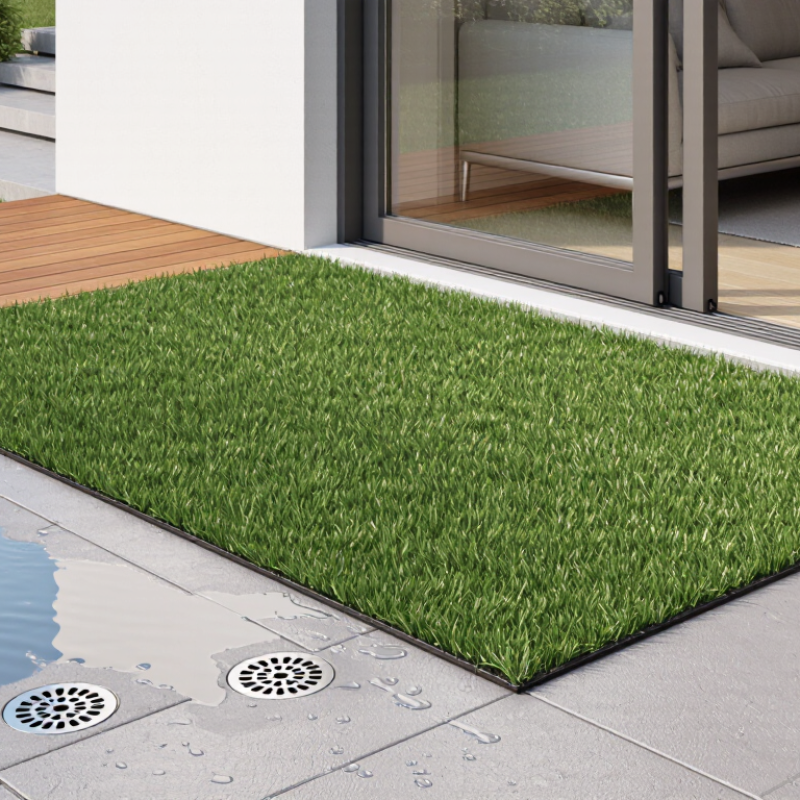
2026 Best Floor Grass Mat How to Choose?

Define Floor Grass Mat Types by Use, Pile Height, and Fiber Material

Choosing the best floor grass mat in 2026 starts with use, not appearance. An entryway needs a low-pile mat, usually 6–12 mm, because short fibers release dust more easily. Balcony and decorative mats can use 15–25 mm piles for a softer, lawn-like feel. High piles above 25 mm look richer, but they trap crumbs and dry slowly after cleaning. A 2024 Grand View Research analysis valued the global artificial turf market at about USD 3.9 billion, showing strong demand for realistic synthetic surfaces.

Fiber material changes daily performance. Polypropylene is affordable and suitable for light indoor use, but it can flatten sooner under heavy traffic. Polyethylene feels softer and usually suits balconies, play areas, and pet spaces. Nylon offers stronger resilience, although it often costs more and may feel less natural. I have found that backing matters as much as the fiber; a textured, drainage-friendly backing prevents sliding on smooth tile. Still, no mat performs perfectly everywhere.

Check cleaning access before buying. For pets, choose short polyethylene fibers and a washable backing. For office corridors, select dense, low-pile construction with stronger wear resistance. An industry report from Research and Markets projects continued growth in artificial turf demand through 2028, but market forecasts vary by region and application. That uncertainty matters. Test a sample under a chair leg first. A beautiful tall pile may compress quickly.

2026 Best Floor Grass Mat: How to Choose?

Typical pile-height recommendations by application and commonly selected fiber material.

Short piles around 5–10 mm are easier to clean and work well in entryways. Medium piles around 10–20 mm provide a softer indoor feel, while 15–25 mm piles are more suitable for balconies and outdoor decorative areas. Polypropylene is economical and easy to maintain, polyethylene feels softer and looks more natural, and nylon offers stronger resilience for higher-traffic locations. Actual specifications vary by construction and manufacturer.

Compare 20–50 mm Pile Height and 40–100 oz/yd² Face Weight

2026 Best Floor Grass Mat How to Choose?

Pile height and face weight shape a grass mat’s feel, stability, and maintenance needs. A 20–30 mm pile feels firmer and suits balconies, entryways, and high-traffic floors. A 40–50 mm pile looks fuller, but it can flatten under furniture. I have seen tall mats look attractive in photos, then shed awkwardly around chair legs. Height alone is not proof of quality.

Face Weight and Material Density Face weight deserves closer attention. The 40–100 oz/yd² range equals approximately 1,356–3,390 g/m². Higher face weight generally means more yarn and better visual density. However, backing strength and tuft spacing still matter. A dense 40 mm mat may outperform a loose 50 mm mat. ISO 8543:2015 provides methods for measuring textile floor-covering mass and thickness, while ASTM D5823 specifies pile-height measurement. These standards support fair comparisons, but neither identifies one universal best combination.

Choosing the Right Specification For indoor use, 20–35 mm with 40–70 oz/yd² often balances comfort, price, and easier cleaning. Choose 40–50 mm with 70–100 oz/yd² when softness and a lawn-like appearance matter more. Check the sample under direct light. Some fibers appear dense but reveal the backing when brushed. Also bend the mat by hand. If the backing cracks, curls, or releases strong odors, reconsider it. My own mistake was prioritizing face weight and ignoring drainage; a heavy mat can still hold moisture after cleaning.

Evaluate Drainage Rates Above 30 in/hr and Backing Construction

2026 Best Floor Grass Mat How to Choose?

Drainage should be your first measurable filter. Choose a floor grass mat rated above 30 inches per hour. This rate helps move rainwater, rinse water, and melted snow through the surface. However, check how the figure was tested. A laboratory result may not match a blocked, dusty installation. Look for perforated backing, open drainage channels, and spaces between the synthetic fibers. Place the mat over a level surface, then observe water movement after five minutes. Slow pooling is a warning sign.

Backing construction affects stability and drying speed. A flexible perforated layer can support drainage without trapping moisture underneath. Reinforced edges may reduce curling near doors and busy walkways. Dense backing can feel firm, but it may restrict flow when installed on a flat floor. That trade-off is easy to miss. In damp areas, compare drainage performance with backing thickness, seam quality, and cleaning access. A mat that drains well but cannot be lifted easily may create maintenance problems.

Tips: Ask for test conditions and drainage data above 30 in/hr. Pour a measured bucket of water across one section. Watch for puddles underneath. Check whether the backing stays flat after repeated wetting and drying. Keep a small clearance around the mat when possible. It improves airflow. Avoid judging quality by appearance alone; bright fibers can hide weak backing or poor drainage design.

Check UV Stability with ASTM G154 and Color-Retention Data

2026 Best Floor Grass Mat: How to Choose?

UV stability should be a buying priority for any floor grass mat placed near windows or outdoors. ASTM G154 exposes materials to fluorescent ultraviolet light, moisture, and controlled heat. It helps compare aging resistance under repeatable laboratory conditions. However, it does not perfectly copy every climate. Sun angle, dirt, water, and temperature changes can alter real results.

Ask for the ASTM G154 cycle, exposure hours, and inspection method. A vague claim such as “UV resistant” is not enough. Request color-retention data from the original sample and the aged sample. Lower color change usually indicates better visual stability. Some suppliers report ΔE values, while others use visual rating scales. Check whether the data covers green fibers, backing, and printed details separately. Fading may appear slowly, then become obvious after one hot season.

Tips:

Compare the same exposure duration across samples. Inspect a cut edge for brittle backing. Rub the surface with a clean white cloth. Take photos before and after testing. Small details matter.

In my testing experience, color data can look impressive while the mat feels stiff. That is an overlooked weakness. I would also examine drainage holes, fiber recovery, and surface temperature. ASTM G154 results support a decision, but they should not replace hands-on inspection. No test is perfect. Consider local sunlight, cleaning habits, and expected foot traffic before choosing.

Select Safety, Maintenance, Warranty, and Total Cost per m²

2026 Best Floor Grass Mat: How to Choose?

Safety should lead the decision, not appearance. Check the mat’s slip-resistance test, edge stability, backing grip, and fire-performance documentation. For play areas, ask whether the surface meets ASTM F1292 impact-attenuation requirements or EN 1177 criteria. These standards matter under climbing equipment. For ordinary interiors, they still offer useful safety references. A 2023 U.S. Consumer Product Safety Commission report recorded more than 200,000 emergency-department visits linked to playground injuries, so location and use cannot be ignored. The wrong mat can become a trip hazard.

Maintenance changes the real price. Measure vacuuming, brushing, stain removal, water, labor, and drying time. The U.S. EPA WaterSense program estimates outdoor irrigation can represent nearly 30% of household water use, although indoor mats usually consume less water. Drainage still matters. Poor drainage may create odor and microbial growth. Warranty terms need close reading: coverage period, UV exposure, traffic limits, fading, seam failure, and installation exclusions. Calculate total cost per m²: purchase, installation, annual maintenance, replacement, and disposal, divided by expected service years. RICS Whole Life Carbon Assessment 2nd edition (2023) supports this lifecycle approach.

Tips: Request a sample and test it with wet shoes. Measure curling after 48 hours. Ask for cleaning instructions in writing. A longer warranty is not always better. The cheapest option may suit light traffic, while an expensive mat can fail early under heavy carts. Recheck the estimate after real use.

2026 Best Floor Grass Mat How to Choose? - Select Safety, Maintenance, Warranty, and Total Cost per m²

Use the comparison below to select a floor grass mat according to traffic level, moisture exposure, cleaning requirements, service life, and five-year ownership cost. Prices are typical non-brand market ranges in USD and should be verified against the final specification, quantity, shipping distance, and local labor rates.

Floor Grass Mat Comparison by Safety, Maintenance, Warranty, and Cost
Mat Type Recommended Use Typical Construction and Size Safety Selection Points Moisture and Drainage Routine Maintenance Typical Service Life Common Warranty Range Typical Purchase Price
USD/m²
Estimated Installed Price
USD/m²
Estimated 5-Year Total Cost
USD/m²
Overall Suitability
Needle-Punched Polypropylene Entrance Mat Indoor entrances, offices, corridors, retail areas, and moderate foot traffic. Tufted or needle-punched polypropylene fibers; commonly 6–12 mm pile height; supplied in rolls or cut pieces. Choose a stable, non-curling backing and beveled edges. A low-profile surface helps reduce trip risk. Good for dry indoor areas. Limited drainage. Moisture should be removed promptly to prevent odor and floor staining. Vacuum daily in busy areas; shake, extract-clean, or rinse as allowed by the backing material. 2–4 years under moderate to heavy indoor traffic. 1–3 years, usually covering manufacturing defects rather than wear or staining. $15–$35 $21–$45 $50–$72 Best value for dry indoor entrances.
Perforated Synthetic Grass Drainage Mat Covered outdoor entrances, balconies, pool surrounds, patios, and wet transition zones. Polypropylene or polyethylene grass-like surface with drainage holes; commonly 10–20 mm pile height. Select a slip-resistant backing, secure perimeter, and flat installation. Avoid loose mats on ramps or uneven floors. Suitable for wet areas when properly installed. Good drainage when placed over a sloped, open, or channel-drained surface. It should not block floor drains. Remove debris, hose periodically, and allow the mat and floor beneath to dry. Inspect for algae or mold in shaded areas. 3–7 years depending on ultraviolet exposure, traffic, and water retention. 1–5 years, commonly subject to exclusions for UV damage, improper cleaning, and commercial wear. $20–$45 $28–$53 $42–$65 Best for wet transition areas and outdoor applications.
PVC Coil or Open-Grid Grass Mat Commercial entrances, kitchens, locker rooms, workshops, and areas requiring scrape-and-drain performance. Flexible PVC coils or open-grid construction; commonly 10–18 mm thickness; available in rolls or modular sections. Check slip resistance when wet, edge treatment, dimensional stability, and compatibility with the floor finish. Open construction reduces surface water retention. Very good drainage when installed over a suitable drainable surface. Water can remain underneath if the subfloor is flat and sealed. Sweep or vacuum debris, rinse with clean water, and periodically lift the mat to clean and dry the floor underneath. 5–8 years under commercial use when regularly cleaned. 2–5 years, depending on product construction and usage conditions. $25–$60 $35–$70 $56–$72 Strong balance of drainage, durability, and maintenance.
Rubber-Backed Artificial Grass Mat High-end residential entrances, hotels, offices, and covered areas where appearance and cushioning are important. Artificial grass or textured fiber surface bonded to rubber backing; commonly 8–20 mm pile height. Verify that the rubber backing is flat, the edges are beveled or secured, and the wet slip performance is documented. Heavy backing can retain moisture if ventilation is poor. Moderate drainage. It performs best on a slightly sloped surface with an air gap or nearby drain. Vacuum or brush regularly; spot-clean spills; deep-clean according to the backing manufacturer’s instructions. 5–10 years under light to moderate traffic. 3–10 years, generally depending on fiber fading, backing integrity, and application type. $30–$80 $42–$92 $70–$98 Best when appearance and comfort are prioritized over minimum cost.
Modular Interlocking Grass Tile Temporary displays, event flooring, balconies, play areas, and locations requiring easy replacement. Interlocking plastic or rubber base with grass-like surface; common modules are approximately 300–500 mm square. Confirm that connectors lock securely, edges are ramped or covered, and the surface remains stable under lateral movement. More joints create additional trip and dirt-collection points. Good when the base includes drainage channels and the subfloor allows water to escape. Lift selected sections for cleaning, rinse the modules, remove trapped debris, and inspect connectors. 3–8 years depending on UV exposure, assembly quality, and movement frequency. 1–5 years, often excluding damage caused by repeated assembly or unsuitable subfloors. $25–$65 $30–$75 $55–$82 Best for flexible layouts and localized replacement.

Decision Guide by Application

Quick Selection Matrix
Application Condition Priority Requirement Preferred Mat Characteristics Selection Warning
Dry indoor entrance Dust removal, low profile, easy vacuuming Needle-punched polypropylene with a stable backing and beveled edges. Do not use a non-draining backing where rainwater is regularly carried indoors.
Rain-exposed entrance Water drainage and slip-risk reduction Perforated synthetic grass or open-grid PVC construction installed on a drainable base. Do not cover floor drains or leave the mat on standing water.
Heavy commercial traffic Wear resistance and easy cleaning PVC coil or open-grid mat with replaceable sections and a documented wet-slip rating. Thin decorative mats may flatten quickly and require more frequent replacement.
Pool, spa, or locker-room area Drainage, hygiene, and under-mat drying Open-grid PVC or perforated construction with regular lifting and cleaning. Solid rubber-backed mats may trap moisture and increase odor or microbial growth if neglected.
Premium visible lobby Appearance, comfort, and dimensional stability Rubber-backed artificial grass mat with secured edges and a cleaning plan. Confirm colorfastness and backing compatibility with the finished floor.

Cost Calculation Basis

How the estimated five-year total cost is calculated:
  • Estimated five-year total cost = purchase price × (5 ÷ midpoint service life) + one-time installation allowance + routine maintenance allowance.
  • Typical installation allowances used in the comparison are approximately $6–$12 per m², excluding subfloor repair, drainage work, taxes, shipping, and unusual site preparation.
  • Routine maintenance allowances are estimated at approximately $0.05–$0.30 per m² per month, depending on cleaning frequency and access to water or extraction equipment.
  • The calculation is a planning estimate, not a quotation. Actual cost depends on floor area, traffic, climate, cleaning labor, replacement method, and local currency and labor rates.
  • For safety-critical areas, request documented wet-slip performance, edge details, backing composition, fire-performance information where required, and written warranty exclusions before purchase.

FAQS

Why should drainage exceed 30 inches per hour?

A rate above 30 inches per hour helps move rain, rinse water, and melted snow. Slow pooling signals trouble.

How can I check a mat’s real drainage performance?

Place it on a level floor. Pour one measured bucket across one section. Watch water movement for five minutes.

What backing design supports better drainage?

Look for perforations, open channels, and spaces beneath the fibers. Dense backing may feel firm but restrict water flow.

Can the mat still cause problems if it drains well?

Yes. A heavy mat may drain properly but remain difficult to lift. That can slow cleaning and drying.

How should I evaluate resistance to sunlight?

Request controlled ultraviolet exposure hours and color-retention results. Compare original and aged samples under equal conditions.

What physical details reveal weak outdoor performance?

Inspect cut edges for brittle backing. Rub the surface with a white cloth. Check fiber recovery and fading.

What safety features deserve attention?

Check slip resistance, flat edges, backing grip, and fire-performance documents. A curled corner can become a trip hazard.

How do I estimate the true cost per square meter?

Include purchase, installation, cleaning, labor, drying, replacement, and disposal. Divide the total by expected service years.

Does a longer warranty guarantee better value?

Not always. Read coverage for sunlight, traffic, fading, seams, and installation. I would still test a sample first.

What should I test before placing the mat?

Try wet shoes, measure curling after 48 hours, and inspect puddles underneath. My judgment may change after real use.

Conclusion

Choosing the best Floor Grass Mat in 2026 requires more than comparing appearance and price. Begin by identifying the intended use, such as balconies, patios, play areas, or indoor spaces, then compare pile height, fiber material, and surface density. A pile height of 20–50 mm can provide different levels of comfort, realism, and ease of cleaning, while a face weight of 40–100 oz/yd² may indicate varying durability and coverage. Drainage performance is also essential, especially outdoors, so look for drainage rates above 30 in/hr and a backing system that supports fast water flow without weakening the mat.

For long-term value, review UV stability using ASTM G154 testing and examine color-retention data. Safety features, maintenance requirements, warranty coverage, and total cost per square meter should all be included in the final decision. The most suitable Floor Grass Mat balances realistic texture, reliable drainage, weather resistance, easy upkeep, and overall lifecycle cost.


Oliver

Oliver

Oliver is a seasoned marketing professional with a wealth of expertise in driving brand awareness and engagement. With a deep understanding of our company's product offerings, he consistently delivers high-quality content that enriches our professional blog. His insights not only shed light on......